Scales
Table of Contents
- 1. Objects
- 2. Phenomena
- 2.1. Time–energy diagram
- 2.2. Interpretation and provenance
- 2.3. Editable envelope parameters
- 2.3.1. 01. Radiative decay
- 2.3.2. 02. Rotational motion
- 2.3.3. 03. Vibrational motion
- 2.3.4. 04. Internal conversion / intersystem crossing
- 2.3.5. 05. Vibrational relaxation
- 2.3.6. 06. Collisions in liquids
- 2.3.7. 07. Predissociation reactions
- 2.3.8. 08. Harpoon reactions
- 2.3.9. 09. Norrish reactions
- 2.3.10. 10. Dissociation reactions
- 2.3.11. 11. Proton transfer
- 2.3.12. 12. Abstraction / exchange / elimination
- 2.3.13. 13. Diels–Alder
- 2.3.14. 14. Cage recombination
- 2.3.15. 15. Protein motions
- 2.3.16. 16. Photosynthesis (electron transfer)
- 2.3.17. 17. Vision (isomerization)
- 2.3.18. 18. Radicals: spectroscopy and reactions
- 2.3.19. 19. IVR and reaction products
- 2.3.20. 20. Transition states / reaction intermediates
- 2.3.21. 21. Atomic resolution / single-molecule motion
- 2.3.22. 22. Femtochemistry
- 3. References
1. Objects
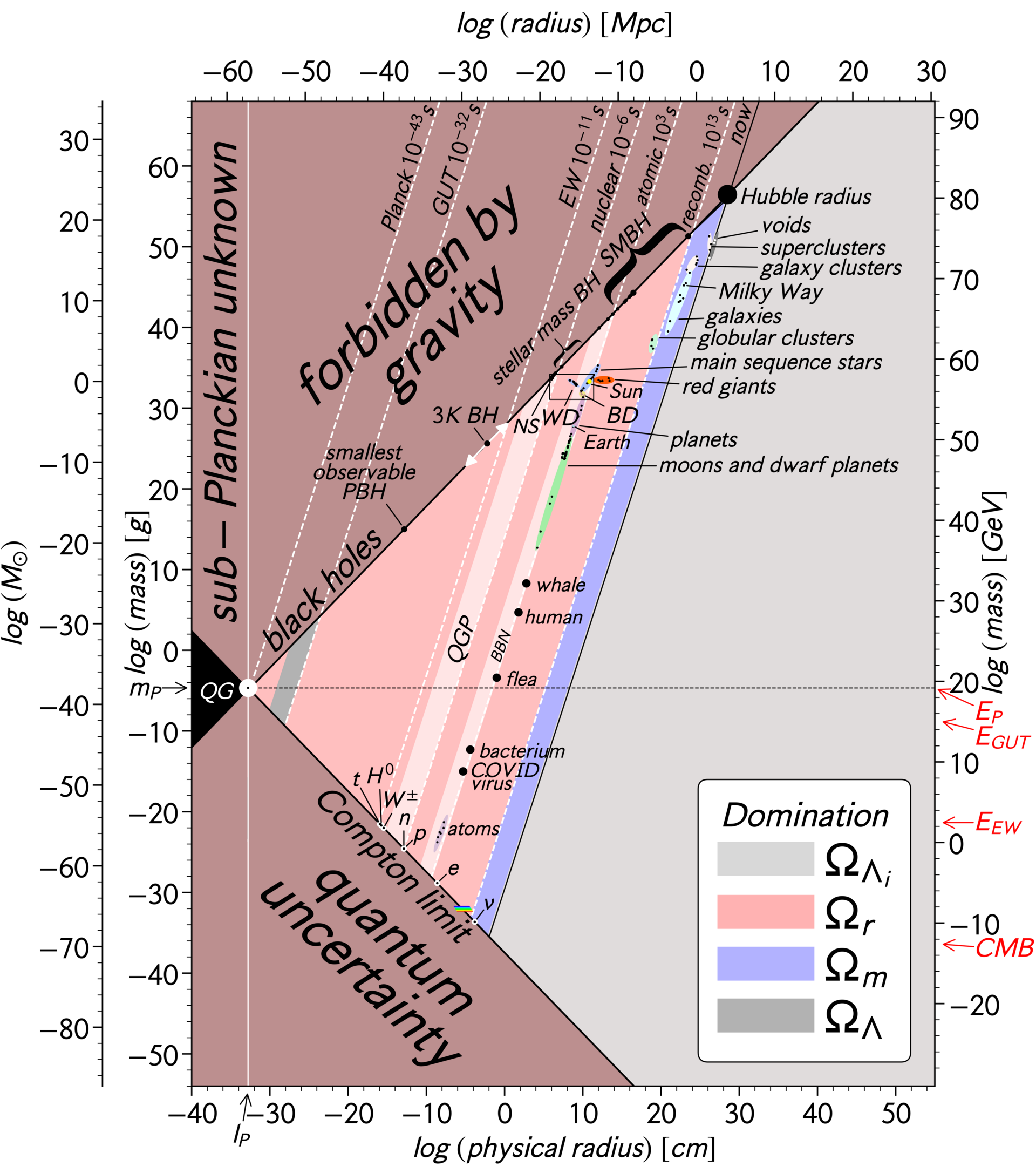
Figure 1: Lineweaver, Patel. All objects and some questions.
2. Phenomena
2.1. Time–energy diagram
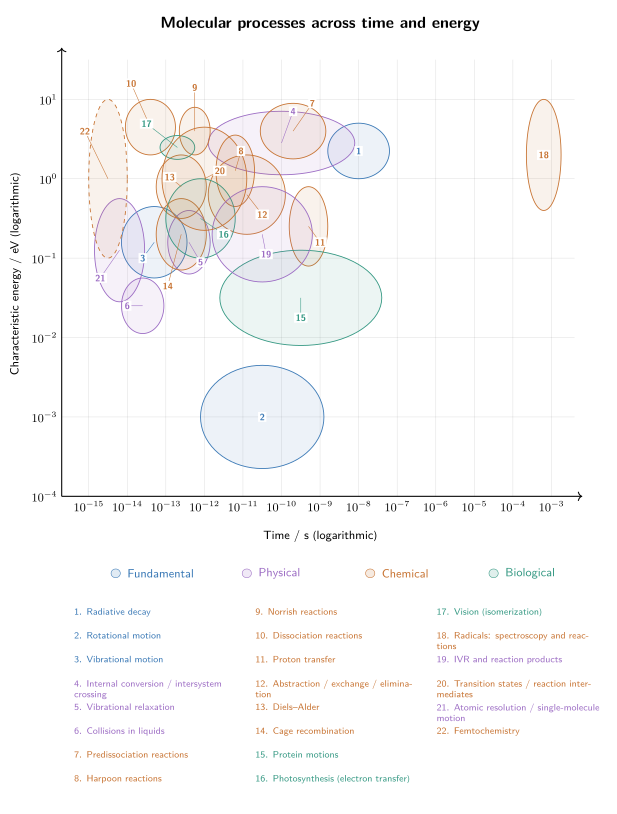
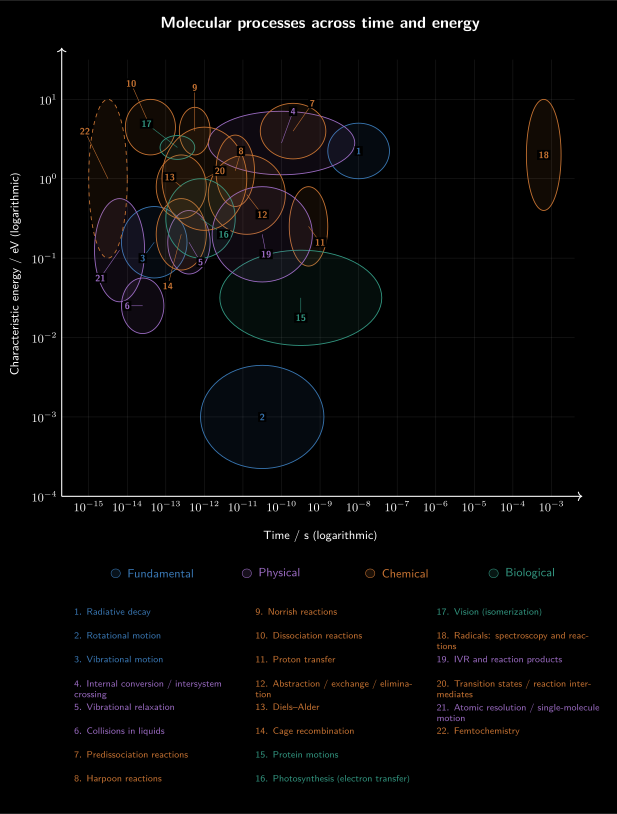
The time ranges follow the supplied historical timescale illustration. Energy is an explicitly identified characteristic scale for each process, not generally \(h/t\), an uncertainty bound, or a common thermodynamic observable. All ellipses are illustrative envelopes, not measured distributions or confidence regions. The original image supplies no energies or covariances. Except for the vision example below, energy centres and widths are editable order-of-magnitude choices, not literature-fitted ranges. Broad categories depend strongly on the molecule, medium and preparation. Reaction-event durations are not bulk reaction times.
Use the numbered key to identify overlapping envelopes; matching text, outlines and translucent fills encode the four categories of the original illustration. Femtochemistry is an umbrella region (dashed), not an additional elementary process.
2.2. Interpretation and provenance
- Zewail, Nobel lecture (1999) provides the historical timescale context. The supplied figure is used for approximate time spans; no numeric covariance has been extracted from it. IVR means intramolecular vibrational redistribution.
- NIST molecular microwave databases and NIST vibrational/electronic levels distinguish rotational, vibrational and electronic energy scales. These are background references, not sources for the individual illustrative matrices below.
- Schoenlein et al. (1991), The first step in vision reports a 500 nm pump and photoproduct formation within 200 fs. Here \(hc/\lambda=2.48\) eV and \(\log_{10}(200\,\mathrm{fs}/\mathrm{s})=-12.70\) set the vision centre; its envelope widths remain illustrative.
- For collisions, \(k_B T\simeq0.026\) eV at 300 K supplies a thermal reference; this is not a measured energy distribution for all liquid collisions.
- Barrier heights, photon energies, vibrational quanta and driving forces are distinct quantities. Comparing their vertical positions does not imply an energy–time law. No correlations are inferred: cross-covariances start at zero.
2.3. Editable envelope parameters
Let \(z=(\log_{10}(t/\mathrm{s}),\log_{10}(E/\mathrm{eV}))^T\). Each parameter block returns \((\mu,\Sigma)\) as a list containing a two-element centre and a symmetric \(2\times2\) covariance-shaped matrix, in squared decades. The plotted boundary is \((z-\mu)^T\Sigma^{-1}(z-\mu)=1\). For diagonal matrices, \(\sqrt{\Sigma_{tt}}\) and \(\sqrt{\Sigma_{EE}}\) are the horizontal and vertical half-widths in decades. Keep \(\Sigma\) positive definite. The renderer consumes each block's returned value, and uses a Cholesky map, so nonzero cross-covariances work without changing the drawing code.
2.3.1. 01. Radiative decay
Energy meaning: Emitted visible/UV photon.
'((-8 0.35) ((0.6400 0) (0 0.1225)))
2.3.2. 02. Rotational motion
Energy meaning: Rotational level spacing.
'((-10.5 -3) ((2.5600 0) (0 0.4225)))
2.3.3. 03. Vibrational motion
Energy meaning: Vibrational quantum.
'((-13.3 -0.8) ((0.7225 0) (0 0.2025)))
2.3.4. 04. Internal conversion / intersystem crossing
Energy meaning: Electronic excitation scale; not the crossing gap.
'((-10 0.45) ((3.6100 0) (0 0.1600)))
2.3.5. 05. Vibrational relaxation
Energy meaning: Vibrational quantum being relaxed.
'((-12.4 -0.8) ((0.3025 0) (0 0.1600)))
2.3.6. 06. Collisions in liquids
Energy meaning: Thermal kinetic scale near room temperature.
'((-13.6 -1.6) ((0.3025 0) (0 0.1225)))
2.3.7. 07. Predissociation reactions
Energy meaning: Electronic excitation.
'((-9.7 0.6) ((0.7225 0) (0 0.1225)))
2.3.8. 08. Harpoon reactions
Energy meaning: Charge-transfer energy scale.
'((-11.2 0.1) ((0.2500 0) (0 0.2025)))
2.3.9. 09. Norrish reactions
Energy meaning: UV excitation.
'((-12.25 0.6) ((0.1600 0) (0 0.0900)))
2.3.10. 10. Dissociation reactions
Energy meaning: Bond dissociation energy.
'((-13.4 0.65) ((0.4225 0) (0 0.1225)))
2.3.11. 11. Proton transfer
Energy meaning: Illustrative activation barrier.
'((-9.3 -0.6) ((0.2500 0) (0 0.2500)))
2.3.12. 12. Abstraction / exchange / elimination
Energy meaning: Illustrative activation barrier.
'((-10.9 -0.2) ((1.0000 0) (0 0.2500)))
2.3.13. 13. Diels–Alder
Energy meaning: Illustrative barrier; time denotes bond rearrangement, not bulk rate.
'((-12.6 -0.1) ((0.4225 0) (0 0.1600)))
2.3.14. 14. Cage recombination
Energy meaning: Illustrative cage escape/recombination barrier.
'((-12.6 -0.7) ((0.4225 0) (0 0.2025)))
2.3.15. 15. Protein motions
Energy meaning: Thermal/conformational energy scale.
'((-9.5 -1.5) ((4.4100 0) (0 0.3600)))
2.3.16. 16. Photosynthesis (electron transfer)
Energy meaning: Illustrative electron-transfer driving-force magnitude.
'((-12.1 -0.5) ((0.8100 0) (0 0.2500)))
2.3.17. 17. Vision (isomerization)
Energy meaning: Absorbed 500 nm photon: 2.48 eV.
'((-12.7 0.394) ((0.2025 0) (0 0.0225)))
2.3.18. 18. Radicals: spectroscopy and reactions
Energy meaning: Illustrative electronic spectroscopy energy.
'((-3.2 0.3) ((0.2025 0) (0 0.4900)))
2.3.19. 19. IVR and reaction products
Energy meaning: Redistributed vibrational energy.
'((-10.5 -0.7) ((1.6900 0) (0 0.3600)))
2.3.20. 20. Transition states / reaction intermediates
Energy meaning: Illustrative barrier above reactants.
'((-12 0.0) ((1.2100 0) (0 0.4225)))
2.3.21. 21. Atomic resolution / single-molecule motion
Energy meaning: Nuclear-motion energy scale, not spatial resolution.
'((-14.2 -0.9) ((0.4225 0) (0 0.4225)))
2.3.22. 22. Femtochemistry
Energy meaning: Broad vibrational-to-electronic regime; umbrella label.
'((-14.5 0.0) ((0.2500 0) (0 1.0000)))