Linguistics
Table of Contents
- 1. General Linguistics
- 1.1. Phonetics
- 1.2. Phonology
- 1.3. Morphology
- 1.4. Syntax
- 1.4.1. Grammar
- 1.4.1.1. Traditional Grammar
- 1.4.1.2. Syntactic Category
- 1.4.1.3. Grammatical Cateogry
- 1.4.1.3.1. Case
- 1.4.1.3.2. Person-Number-Gender
- 1.4.1.3.3. Tense-Aspect-Mood
- 1.4.1.3.4. Voice
- 1.4.1.3.5. Possession
- 1.4.1.3.6. Definiteness
- 1.4.1.3.7. Politeness
- 1.4.1.3.8. Causativity
- 1.4.1.3.9. Clusivity
- 1.4.1.3.10. Interrogatives
- 1.4.1.3.11. Transitivity
- 1.4.1.3.12. Valency
- 1.4.1.3.13. Polarity
- 1.4.1.3.14. Telicity
- 1.4.1.3.15. Volition
- 1.4.1.3.16. Mirativity
- 1.4.1.3.17. Evidentiality
- 1.4.1.3.18. Animacy
- 1.4.1.3.19. Associativity
- 1.4.1.3.20. Pluractionality
- 1.4.1.3.21. Reciprocity
- 1.4.1.4. Inflection
- 1.4.1. Grammar
- 1.5. Semantics
- 1.6. Pragmetics
- 2. Historical Linguistics
- 3. Interlinear Gloss
- 4. Homonym
- 5. Linguistic Relativity
- 6. Writing Systems
- 7. Sign Languages
- 8. References
1. General Linguistics
1.1. Phonetics
1.1.1. IPA
- International Phonetic Alphabet
1.1.2. Consonants
Consonant is an obstructed airflow.
It is categorized based on the articulatory settings: place and manner of articulation, and voicing.
1.1.2.1. Alveolar
치경, 치조
1.2. Phonology
1.2.1. Phoneme
- 음소
Set of similar speech sounds that are perceptually regarded by the speakers of a language as a single basic sound. In other words, the smallest possible phonetic unit that distinguishes one word from another.
A phoneme can have multiple allophones.
1.2.2. Prosodeme
- Suprasegmental Phoneme, Tone Unit
- 운소
a linguistic unit of sound—such as stress, pitch, tone, or duration—that extends over more than one segment of sound and can change the meaning of a word.
Examples include stress, tone, length (chroneme).
1.2.3. Phonotactics
Branch of phonology that deals with restrictions in a language on the permissible combinations of phonemes.
A syllable consists of
- Onset
- Rhyme
- Nucleus
- Coda
where the nucleus is always required.
1.2.4. Ablaut
The system of apophony (regular vowel variation) in the Proto-Indo-European language. For example, man-men, sing-sang-sung, gibt-gabt.
1.3. Morphology
The study of how words are formed, and how they relate to one another within a language.
1.3.1. Morpheme-based
An approach of morphology in which morphemes are combined to form a word-form. Morpheme is the smallest meaningful constituent of a linguistic expression.
There are free morpheme and bound morpheme. Free morphemes, like cat, can be used by themselves, while bound morphemes, like -s, cannot.
1.3.2. Lexeme-based
There is one lexeme for one concept, and they are modifed based on inflectional rules and form a word-form.
1.3.3. Paradigm
Complete set of related word forms associated with a given lexeme
For examples, conjugation of verbs, declension of nouns.
1.4. Syntax
1.4.1. Grammar
1.4.1.1. Traditional Grammar
Parts of Speech In English, usually,
- Noun
- Verb
- Adjective
- Adverb
- Pronoun
- Preposition
- Conjunction
- Interjection
- Article
1.4.1.2. Syntactic Category
1.4.1.2.1. Lexical Categories
- Word Classes
- A Adjective
- P Adposition
- Adv Adverb
- C Coordinate Conjunction
- D Determiner
- I Interjection
- N Noun
- Par Particle
- Pr Pronoun
- Sub Subordinate Conjunction
- V Verb
- etc.
1.4.1.2.2. Phrasal Categories
- AP Adjective Phrase
- AdvP Adverb Phrase
- PP Adposition Phrase
- NP Noun Phrase
- VP Verb Phrase
- etc.
1.4.1.3. Grammatical Cateogry
1.4.1.3.1. Case
Category of nouns and noun modifiers.
주격 relating to or denoting a case of nouns, pronouns, and adjectives (as in Latin and other inflected languages) used for the subject of a verb.
대격 relating to or denoting a case of nouns, pronouns, and adjectives that expresses the object of an action or the goal of motion.
여격 (in Latin, Greek, German, and other languages) denoting a case of nouns and pronouns, and words in grammatical agreement with them, indicating an indirect object or recipient.
속격 relating to or denoting a case of nouns and pronouns (and words in grammatical agreement with them) indicating possession or close association.
1.4.1.3.2. Person-Number-Gender
1.4.1.3.3. Tense-Aspect-Mood
1.4.1.3.4. Voice
1.4.1.3.5. Possession
1.4.1.3.6. Definiteness
1.4.1.3.7. Politeness
1.4.1.3.8. Causativity
1.4.1.3.9. Clusivity
1.4.1.3.10. Interrogatives
1.4.1.3.11. Transitivity
1.4.1.3.12. Valency
1.4.1.3.13. Polarity
1.4.1.3.14. Telicity
1.4.1.3.15. Volition
1.4.1.3.16. Mirativity
1.4.1.3.17. Evidentiality
1.4.1.3.18. Animacy
1.4.1.3.19. Associativity
1.4.1.3.20. Pluractionality
1.4.1.3.21. Reciprocity
1.4.1.4. Inflection
Affixation or apophony is commonly used.
1.4.1.4.1. Conjugation
Inflection of verbs
1.4.1.4.2. Declension
Inflection of nouns, adjectives, adverbs, etc.
1.5. Semantics
The study of linguistic meaning, in particular context-free meaning. It examines what meaning is, how words get their meaning, and how the meaning of a complex expression depends on its parts.
1.6. Pragmetics
The study of how context contributes to meaning
1.6.1. Grice's Maxims
- Coorperative principle
- Four maxims of conversation, Gricean Maxims
The four maxims are:
- Maxim of quantity (informativity)
- Maxim of quality (truth)
- Maxim of relation (relevance)
- Maxim of manner (clarity)
1.6.2. Speech Act Theory
Locutionary Act: The words themselves Illocutionary Act: The act you're performing by saying them Perlocutionary Act: The effect it has on the listener
2. Historical Linguistics
- Diachronic Linguistics
2.1. Etymology
2.1.1. English
2.1.1.1. Pronouns
Shifted around the Middle English c. 1150 to c. 1470
- 'they' is introduced from the Old Norse language around 1200 A.D.
- 'she' came about around 1200 without distinguished origin.
- 'thou', 'thy', 'thee' were singular second person pronouns, and Ye was plural second person pronoun. The shift happened slowly from 1200 to 1600 due to the French influence of T-V distinction.
- Singular 'they' is about 700 years old, but 300 years ago grammarians prescribed that it is plural.
- Various methods were devised such as 'he or she', generic 'he' or neopronouns were developed to mitigate this rule.
2.1.1.2. Affirmation to Negative Questions
Originally 'Yea' [jɛɪ] and 'Nay' [nɛɪ] was used to affirm and contradict positive questions, and 'Yes' and 'No' was for negative questions.
Specific vocabularies like this exits in other languages:
| Language | Affirm Positive | Affirm Negative | Contradict Positive | Contradict Negative |
|---|---|---|---|---|
| Romanian | da | ba da | nu | ba nu |
| French | oui | si | non | non |
| German | ja | doch | nein | nein |
| Hungarian | igen | de | nem | nem |
2.2. Language Family
- Group of languages that shares the same ancestry.
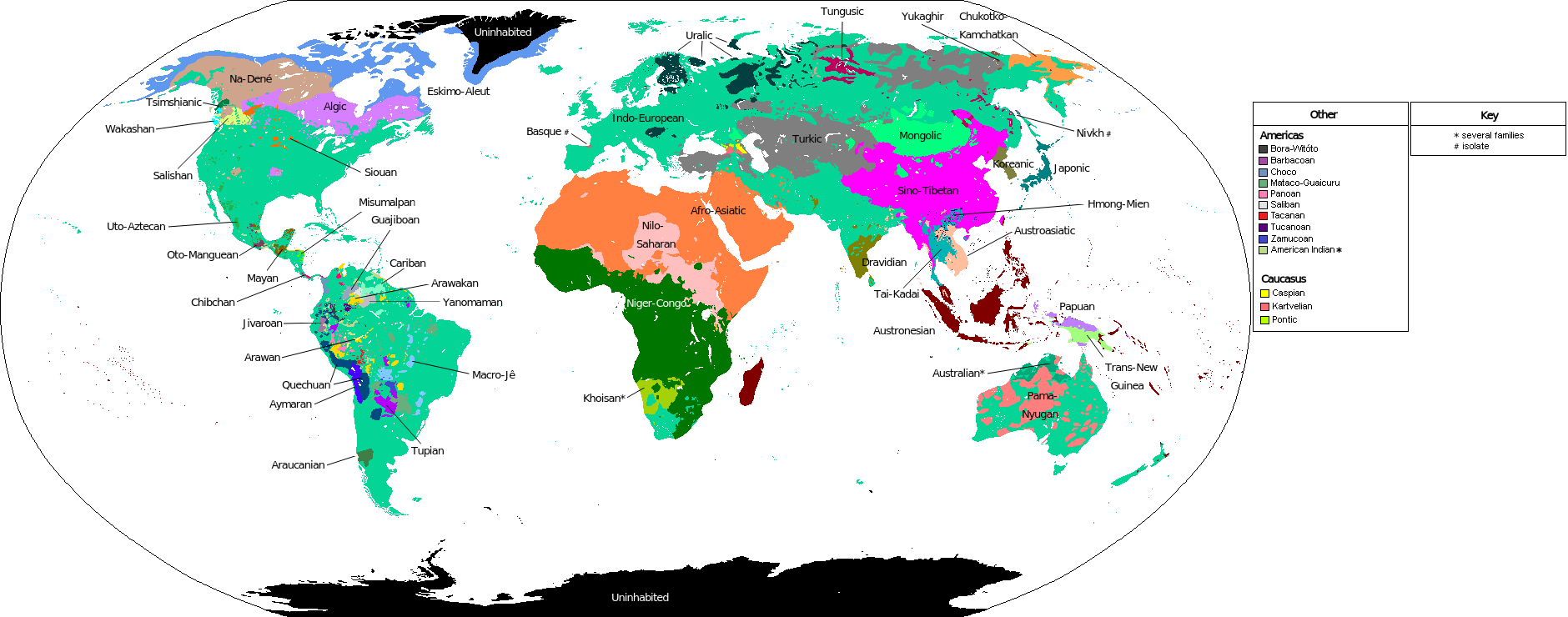
- This shows the distributions of the primary language families.
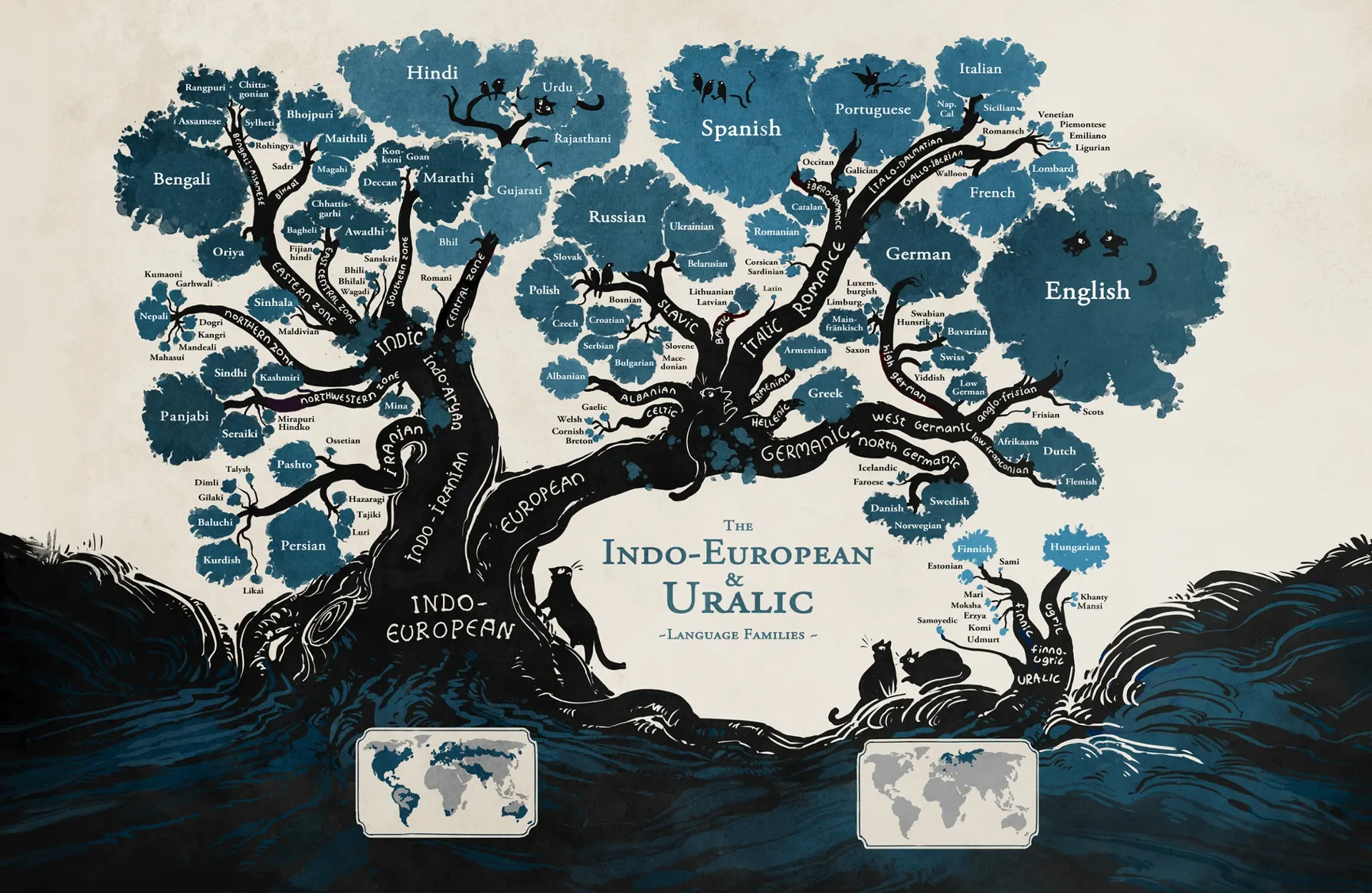
2.2.1. Indo-European
It is the most spoken language family spoken around Europe, Russia, Persia, and India, accounting for 46% of the world population.
2.2.1.1. Romance
- The descendant of the Latin
- Summarizing Romance sound shifts - YouTube
There was 20 letters, with C being the [k] sound, V being the [u] or [w] sound, L being the dark L [ɫ], with additional K, Y, Z to express the Greek words.
2.2.1.1.1. Western-Romance
Spanish
- some f are replaced with h
- Large germanic influences
French
2.2.1.1.2. Eastern-Romance
- Heavy Slavic influences
2.2.1.2. Germanic
2.2.1.2.1. West Germanic
Frisian
- spoken in the coastal region of the Netherlands and Germany
2.2.2. Sino-Tibetan
- Spoken around China, Myanmar, etc.
Chinese and Tibetan
2.2.3. Niger-Congo
- Sub-Saharan Africa
- It is a hypothetical language family, as we are not sure of it.
2.2.4. Afroasiatic
- Also known as Hamito-Semitic.
- It is the fourth largest language family.
- North Africa
- Mesopotamia
- Arabian peninsula
2.2.4.1. Semitic
Hebrew
2.2.5. Koreanic
2.2.6. Japonic
3. Interlinear Gloss
4. Homonym

5. Linguistic Relativity
- Sapir-Whorf Hypothesis
Language influences worldview or cognition.
The strong hypothesis that says language limits and determines thought has been rejected by the linguists, while the weak hypothesis that says language can nudge perception in some domains has experimental evidences.
It is clear to me that vocabulary help one to think more structurally.
6. Writing Systems
6.1. Abjads
Symbols only for consonants, with optional diacritics for vowels. e.g. Hebrew, Arabic.
6.2. Alphabets
Separate symbols for consonants and vowels. e.g. Latin.
6.3. Abugidas
Base symbol for a consonant-vowel pair, and it is modified for different vowels. e.g. Devanagari.
6.4. Syllabaries
One symbol for each syllable. e.g. Japanese.
6.5. Logo-syllabaries
One symbol for each syllable, and those symbol is also an logogram or pictogram. e.g. Chinese.
7. Sign Languages
Sign languages are separate language from its verbal counterparts. They have their own grammar and vocabulary.
8. References
- ALL of Linguistics, explained - YouTube
- A Brief History of English Pronouns - YouTube
- Syntactic category - Wikipedia
- Grammatical case - Wikipedia
- Grammatical conjugation - Wikipedia
- Inflection - Wikipedia
- Part of speech - Wikipedia
- How to learn the IPA (part 1): accelerate your language learning - YouTube
- IPA consonant chart with audio - Wikipedia
- Homonyms - YouTube
- Linguistic relativity - Wikipedia
- Writing Systems of the World - YouTube