Inorganic Chemistry
Table of Contents
1. Symmetry
1.1. Point Group
1.1.1. Schönflies Notation
1.1.1.1. Symmetry Operations
- Cₙ Rotation: n-fold rotation
- σ Reflection
- σₕ Horizontal Reflection: reflection with respect to the plane perpendicular to the principal axis.
- σᵥ Vertical Reflection: reflection with respect to the plane parallel to the principal axis.
- i Inversion
- S₂ₙ Improper Rotation: Rotation about an axis and reflection along the axis.
- From German Spiegel 'mirror'
1.1.1.2. Point Groups
- \( C_1 \) Only identity
- \( C_i \) Identity and inversion
- \( C_s \) Identity and improper rotation
- \( C_{\infty v} \) Linear along an axis and vertical reflections
- \( D_{\infty h} \) Linear along an axis and horizontal reflections
- \( C_{n} \) (Cyclic) Only rotations along a single axis are possible
- \( C_{nv} \) (Pyramidal) Rotations and vertical reflections
- \( C_{nh} \) (Reflection) Rotations and horizontal reflection
- \( D_n \) (Dihedral) Rotations and 2n C₂ rotations perpendicular to principal axis.
- \( D_{nh} \) (Prismatic) Dihedral and horizontal reflection
- \( D_{nd} \) (Antiprismatic) Dihedral and dihedral (vertical) reflections
- \( S_n \) Dihedral and improper rotations
- \( T, T_h, T_d \) (Tetrahedral)
- \( O, O_h \) (Octahedral)
- \( I, I_h \) (Icosahedral)
1.1.2. Hermann-Mauguin Notation
- International Notation
- It is the standard in International Tables For Crystallography.
1.1.2.1. Symmetry Operations
- n Rotation: n-fold rotation
- m Reflection
- n/m the mirror plane is perpendicular to the n-fold rotation axis,
- n̄ Rotoinversion: rotation by 2π/n and inversion
- \(\bar{1}\) is the pure inversion
1.1.2.2. Point Groups
The symmetries in primary, secondary, tertiary directions are listed in order. The secondary directions are the all equivalent directions perpendicular to the primary direction, and tertiary directions are all equivalent directions between secondary directions. Note that the tertiary directions only occur when the rotational symmetry around the primary direction is even.
When the rotational symmetry is more than 10-fold, paranthesis is used to make it clear that it is not rotational symmetries along two directions.
Translation from Schönflies notation
- \( n \): \( C_n \)
- \( nm, nmm \): \( C_{nv} \). one \( m \) if \( n \) is odd, two \( m \) if \( n \) is even.
- \( \tfrac{n}{m} \): \( C_{nh} \)
- \( n2, n22 \): \( D_n \)
- \( \bar{n}\tfrac{2}{m} \): \( D_{nd} \)
- \( \tfrac{n}{m}\tfrac{2}{m}\tfrac{2}{m} \): \( D_{nh} \)
1.2. Character
The representation of point group on any vector space can be decomposed into few irreducible representations (irreps). Point group decides which irreps are possible.
Each representation has character, and the characters of irreps are of particular interest. Those are classified and named. e.g. \(A_{1u}\)
- A or B the character is 1 or -1 in the primitive rotation
- 1 or 2 the character is 1 or -1 in one of the reflection
- g or u (gerade and ungerade) the character is 1 or -1 in the inversion
- E for two dimensional representation, T for three dimensional
The specific reflection is determined by convention.
1.3. Hückel Method
- Hückel Molecular Orbital Theory
1.4. Term Symbol
The atomic quantum state that include all the states of its electron. This is exactly the change of basis what Clebsh-Gorden coefficients describe. Single electronic orbital configuration corresponds to multiple term symbols. For example \(p^2\) configuration can be in either \(^1D\), \(^3P\), or \(^1S\).
Term symbol describe the total orbital angular momentum \(L\) and total spin angular momentum \(S\). e.g. \({}^5F\). The angular momentum can be rotated and be measured between \(-L\) and \(L\) (or \(-S\) and \(S\)) with respect to one axis.
- S, P, D, F, G, H, I, … for total orbital angular momentum 0, 1, 2, 3, 4, 5, 6…
- frontal superscript means the spin multiplicity
Hund's rule determine the ground state with following:
- The ground state has the highest spin multiplicity
- For the same spin multiplicity states, the ground state has the highest \(L\).
Each microstate in term symbol, can be divided further, depending on spin-orbit coupling or irreps.
2. Coordination Chemistry
2.1. Coordination Compound
- 착화합물
Created from Lewis acid and Lewis base by covalent bond. The lone pair of Lewis base donates the electron pair.
2.1.1. Notation and Nomenclature
Chemical Formula
- For ionic compound, write cation first
- Write central (metal) atom first
- Write anionic ligands in alphabetical order (of the name, not formula)
- Write neutral ligands in alphabetical order
- Surround with square bracket and add ionic charge to that
e.g. \(\ce{[CoCl2(NH3)4]+}\)
Nomenclature
- Read cation first
- Read ligand first and then metal
- Read ligands in alphabetical order
- The suffix of metal changes to -ate when the overall charge is negative.
- Add oxidation state of the metal at the end
e.g.
Some of metals have special name for its anion form:
- Fe: ferrrate
- Ag: argentate
- Sb: Stibate
- Pb: plumbate
- Sn: stannate
- Au: aurate
Transition metal does not have predetermined oxidation number, so notating it is important.
2.1.2. Abbreviations
We use abbreviation for complicated ligands
- Halogen often ends in -o.
| Formula | Abbreviation | Structure |
|---|---|---|
| I | iodo | |
| Br | bromo | |
| \(\ce{N^3-}\) | nitrido | |
| \(\ce{N3-}\) | axido | |
| \(\ce{O^2-\) | oxido | |
| \(\ce{H2O}\) | aqua | |
| \(\ce{SCN-}\) | thiocyano, thiocyanato (bind to N) | |
| \(\ce{NCS-}\) | isocyano (bind to S) |
2.1.3. Isomers
Stereoisomers Stereochemical description can be done with prefixes:
- trans- and cis-
- fac- (facial) and mer- (meridional)
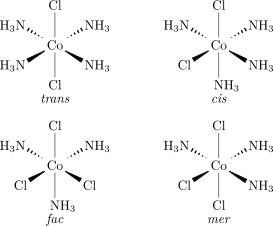
They are diastereomers.
Structural Isomers (or Constitutional Isomers) The covalently bonded atoms can be swapped with the ionically bonded atoms, or other covalently bonded atoms in another complex.
- Hydrate: Hydrate (H2O)-ion swap
- Ionization: Anion-cation swap
- Coordination: Ligand-ligand swap in multi-complex
- Linkage: Ligand orientation difference for bidentate or more
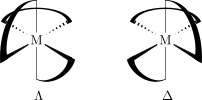
Absolute Configuration
2.2. Ligand
The Lewis base that combine to metal is called ligand.
The number of covalent bond between central metal and the ligands are called the coordination number (CN).
There are multiple types of ligands:
- Chelating Ligand: Ligand donates two or more electron pairs
- Bridging Ligand: Ligand connect two or more metals.
The number of bonds that a single ligand make with metal can be expressed with the adjective: bidentate, tridentate, tetradentate, and so on.
Chelating ligand creates ring formation, in which 5 or 6 membered ring if commonly seen, while 3, 4, 7, 8 membered ring is unstable due to ring strain.
3. Solid State Chemistry
4. Metal-Organic-Framework
- MOF
The 1 nm diameter cavities in MOF can be filled with quantum dots.
5. Jahn-Teller Effect
Any nonlinear molecule with a spatially degenerate electronic ground state will undergo a geometrical distortion that removes that degeneracy, because the distortion lowers the overall energy of the species.
It is common in octahedral complexes of the transition metals
| Number of d electrons | 1 | 2 | 3 | 4 | 5 | 6 | 7 | 8 | 9 | 10 | ||||
| High/Low Spin | HS | LS | HS | LS | HS | LS | HS | LS | ||||||
| Strength of J–T Effect | w | w | s | w | w | w | w | s | s |
6. Renner-Teller Effect
Two electronic states that are degenerate at linearity (when the molecule is straight) are coupled with rovibrational motion, and splits.
7. See Also
- Point Group Visualization. Symmetry Resources at Otterbein University
8. References
- Schoenflies notation - Wikipedia
- Hermann–Mauguin notation - Wikipedia
- Point groups in three dimensions - Wikipedia
- Lattice plane - Wikipedia
- Bravais lattice - Wikipedia
- Crystal system - Wikipedia
- Space group - Wikipedia
- Frank Hoffmann - YouTube. Fascination of Crystals and Symmetry.
- Jahn–Teller effect - Wikipedia
- Renner–Teller effect - Wikipedia